
Is a single-page website good for SEO? This is a common question among business owners who prefer clean, minimal website designs. Single-page websites are visually streamlined and often conversion-focused, but their search performance depends heavily on context. While they can rank in specific situations, they are not always ideal for long-term organic growth. The real issue is not whether the format is “good” or “bad,” but whether it aligns with your overall SEO strategy and growth goals.
Before deciding on structure, it’s important to understand how search engines interpret content architecture. Google does not rank websites based on design preference alone, but on clarity, relevance, structure, and topical depth. The way your content is organized plays a major role in how easily it can compete for rankings. To answer this question properly, we need to look at how single-page websites are evaluated from an SEO perspective.
How Google Evaluates Single-Page Websites
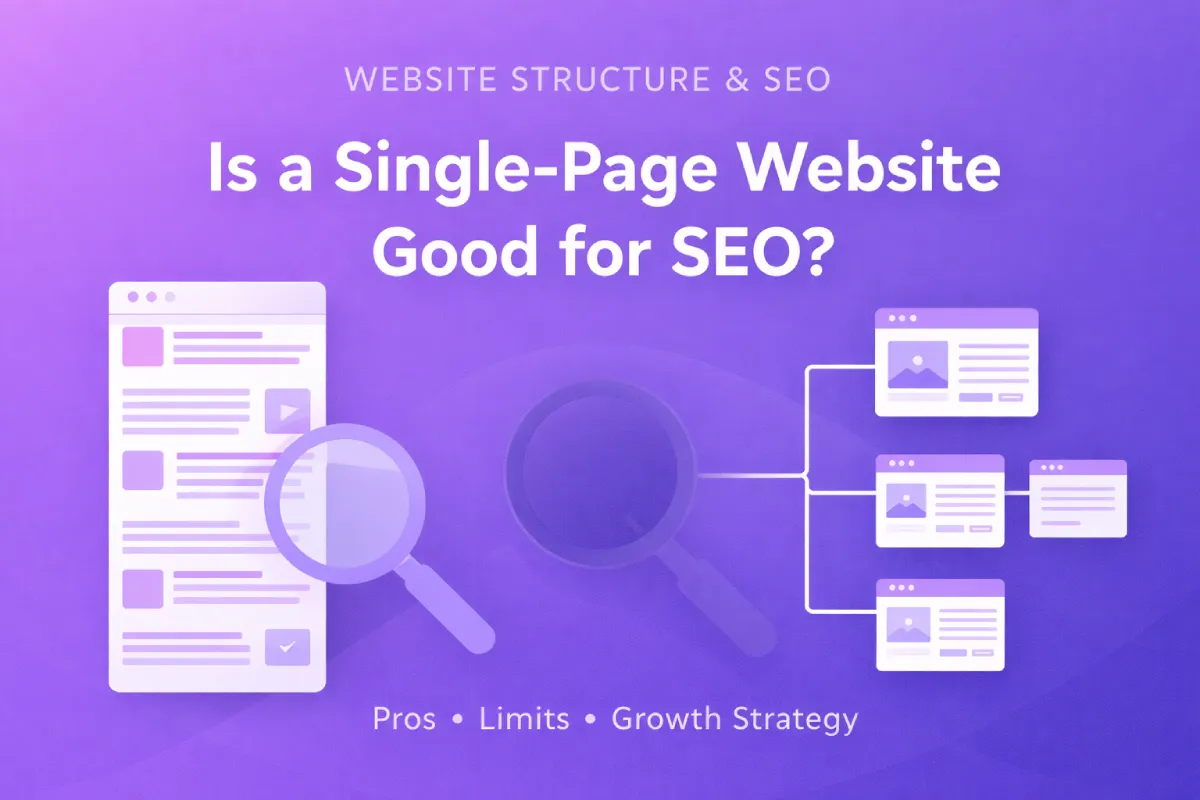
Search engines rank pages based on relevance, structure, internal linking, content depth, and user signals. In a single-page setup, all content exists under one URL, which means Google has limited structural signals to interpret topic hierarchy. Unlike multi-page sites, there are no separate URLs targeting different keyword clusters. This makes it harder to build topical authority across multiple search intents.
Additionally, internal linking — a key SEO strength — becomes minimal in one-page designs. Anchor links help users navigate, but they do not carry the same ranking power as separate optimized pages connected through contextual links.
Is a Single-Page Website Good for SEO in Competitive Markets?
Whether a single-page website is good for SEO largely depends on the level of competition in your niche. In low-competition markets, a well-optimized one-page website can rank effectively by clearly targeting a focused keyword theme. However, in competitive industries where businesses publish multiple service pages and in-depth content, a single URL often struggles to build the same authority.
Search engines tend to reward structured content ecosystems that cover topics comprehensively across multiple pages. When competitors are targeting related subtopics individually, a single-page website may lack the depth and internal linking structure required to compete consistently. This is where keyword strategy becomes a critical deciding factor.
Keyword Targeting Limitations
A single-page website typically performs best when targeting one primary keyword theme. Because there is only one URL, you cannot effectively optimize different sections for entirely separate search intents. For example, ranking for “web design services,” “SEO services,” and “technical SEO audit” on one page creates diluted relevance. Google prefers dedicated pages that deeply address each topic individually. This is where on-page SEO becomes critical, as each page needs focused optimization aligned with a single search intent.
If your business depends on ranking for multiple service-based keywords, a single-page structure can restrict growth. It becomes difficult to expand without restructuring the entire site later.
Content Depth and Topical Authority
Topical authority is built by covering a subject comprehensively across multiple pages. With a multi-page structure, you can create supporting blog posts, service pages, FAQs, and case studies that interlink strategically. A single-page website compresses all information into one long scroll, limiting semantic expansion opportunities.
While long-form content on one page can still rank, it often lacks the architectural clarity that search engines use to determine expertise. Over time, competitors with structured content silos usually outperform single-page sites in competitive industries.
Technical SEO Considerations
Technical SEO implementation is more flexible in a multi-page environment. Each page can have unique meta titles, descriptions, schema markup, and structured data tailored to specific queries. In a single-page site, optimization elements are shared across one URL, which reduces customization opportunities.
This does not mean technical SEO is impossible on a one-page website. However, advanced strategies such as service-specific schema or conversion tracking segmentation become harder to implement effectively.
When a Single-Page Website Can Rank Well
A single-page website can perform well when the business has a narrow focus and clear intent. Local freelancers, consultants, portfolio websites, and campaign pages often succeed with this structure. If the goal is to rank for one primary service in one geographic area, a well-optimized single page can be sufficient. It is especially effective for validation-stage businesses that need visibility without building a large content ecosystem.
A single-page website is more likely to succeed in SEO when:
- You target one primary keyword theme
- Your services are tightly related under one core offering
- Competition in your niche is moderate or low
- Your goal is lead generation rather than large-scale traffic growth
- You plan to rely on paid ads or social traffic alongside organic search
When these conditions align, the simplicity of a single-page structure can support both clarity and conversion without severely limiting visibility.
When It Becomes a Growth Limitation
Problems arise when businesses attempt to scale organic traffic using a single-page structure. As services expand or content marketing becomes part of the strategy, structural limitations start affecting performance. Adding new sections to one long page does not create the same SEO strength as adding new optimized URLs.
If long-term growth, keyword expansion, and authority building are priorities, a multi-page structure provides significantly more flexibility.
So, is a single-page website good for SEO in the long run? The answer depends on how many keywords you plan to target and whether your business intends to scale organic traffic over time.
Strategic Recommendation
Choosing between a single-page and multi-page website should be based on business stage and SEO ambition. If your objective is to generate leads from one focused service, a well-structured landing page can often be more effective than a full single-page website. Many business owners ask, “Is a single-page website good for SEO?” before launching, but the real answer depends on scalability and long-term content plans. However, if you plan to grow organic traffic consistently over time, structured architecture is usually the better long-term investment.
In most industries, scalability matters more than design simplicity. Therefore, the decision should prioritize search strategy rather than visual trend.
Final Answer: Is It Good for SEO?
Yes, a single-page website can rank in search engines, particularly for narrow and localized keywords. However, it is not the most scalable structure for businesses aiming to dominate multiple search terms. Its SEO performance depends on competition level, keyword scope, and long-term content plans.
If growth and authority are your goals, think beyond a single page. SEO success is rarely about minimal structure — it is about strategic depth. Ultimately, whether a single-page website is good for SEO comes down to how much growth you expect from organic search.