
Short answer: For a brand-new website, expect to wait 6–12 months before SEO meaningfully moves the needle. For established sites, you may see real progress in 3–6 months. But here’s the part most guides skip — the first signs of SEO working arrive much earlier than traffic does, and knowing what to look for will keep you sane during the wait.
So, how long does SEO take to work for a new website? The realistic answer depends on multiple factors, but there is a clear pattern most sites follow.
You’ve published your pages. You’ve done your keyword research. You’ve even fixed your site speed. Yet weeks pass, and Google barely blinks. Is it broken? Did you do something wrong?
Probably not. SEO just works on its own schedule — and that schedule is non-negotiable.
In this guide, we’ll walk through a realistic month-by-month SEO timeline for new websites, the factors that speed it up or slow it down, what ‘early wins’ actually look like, and — something almost nobody talks about — how to get cited in Google’s AI Overviews and LLM-powered search results before you even crack the top 10.
How Long Does SEO Take to Work? (Quick Answer)
SEO typically takes 3–6 months for early results and 6–12 months for consistent traffic growth, depending on your website and competition.
- New website: 6–12 months for meaningful organic traffic
- Established site: 3–6 months for noticeable ranking improvements
- Competitive niche: 12–24 months to compete for high-volume keywords
- Local SEO: Fastest — sometimes visible results in 4–8 weeks with Google Business Profile
Why Does SEO Take So Long? The Real Reason
SEO takes time because Google needs to crawl, index, and trust your website before ranking it.
Before we get into timelines, it helps to understand why SEO isn’t instant. The answer comes down to trust.
Google’s entire business model depends on serving the most reliable, accurate, and useful results. Handing a brand-new website top rankings before it has proven itself would be like hiring someone for a senior role with zero work history. Google doesn’t do that.
When you publish a new page, here’s what actually needs to happen before it ranks:
- Discovery: Googlebot needs to find the page, either through an XML sitemap, internal links, or an external link pointing to it.
- Crawling: The crawler reads and processes the page content, structure, and code.
- Indexing: The page enters Google’s database. This alone can take hours to weeks.
- Ranking evaluation: Google tests your page against hundreds of signals — relevance, quality, user experience, authority — and assigns a trial position.
- Rank Transition: Google intentionally introduces ranking volatility to new and recently optimized pages (called the Rank Transition Algorithm), discouraging manipulation and stress-testing where the page truly belongs.
- Stabilization: After weeks or months of testing, your ranking settles into something predictable.
On top of all this, new websites face what the SEO community calls the Google Sandbox — an informal term for the period, typically 1 to 6 months, during which new domains are held to higher scrutiny before gaining full visibility. Google hasn’t confirmed the Sandbox officially, but the pattern is consistent enough that most practitioners treat it as real.
SEO is not slow — it’s delayed compounding.
💡 Key Insight
The wait isn’t a bug. It’s Google doing its job. Spam sites can’t survive a 6–12 month trust-building process, which is exactly why organic rankings are so valuable once you earn them.
The Realistic SEO Timeline: How Long Does SEO Take to Work Month-by-Month
SEO timeline refers to the time it takes for a website to start ranking and generating organic traffic from search engines.
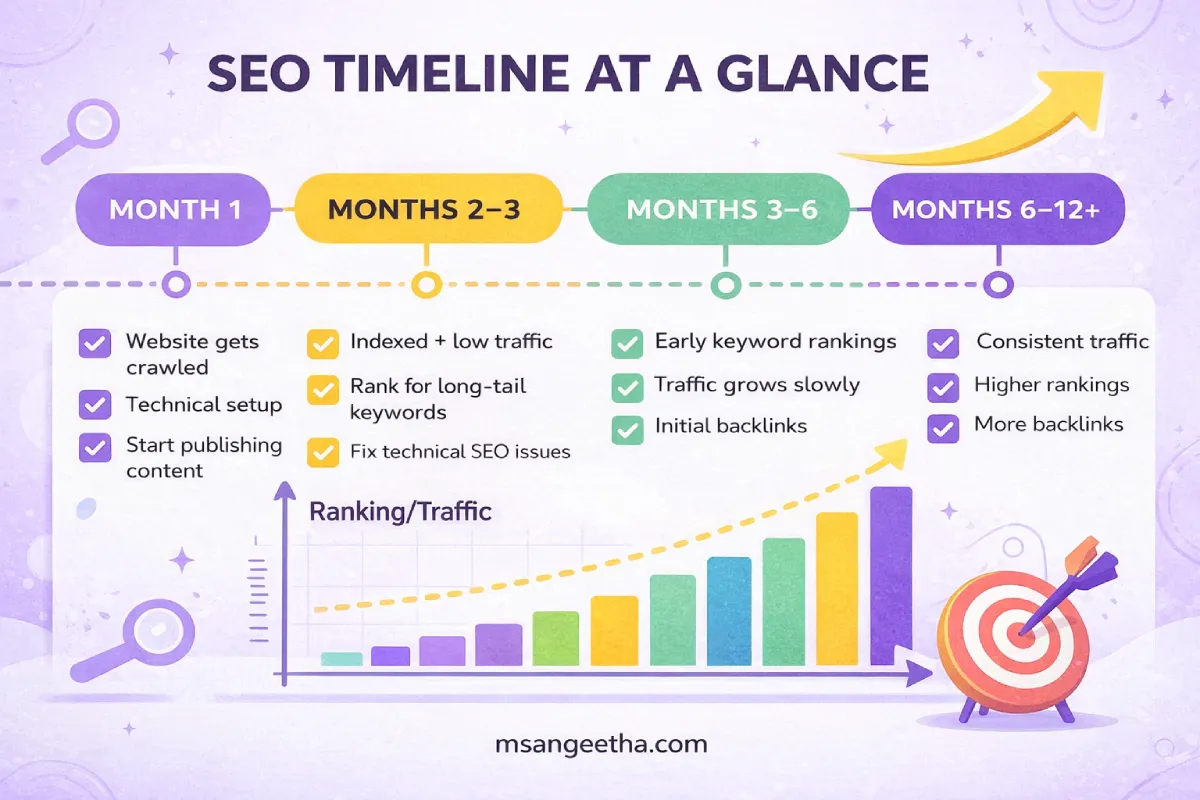
Every website is different, but here is a framework that reflects what most new sites experience when following solid SEO fundamentals consistently:
| Month | Phase | What to Expect |
|---|---|---|
| Month 1 | Foundation | Site audit, technical fixes, Google Search Console & Analytics setup, keyword research, site architecture. No ranking changes yet. |
| Month 2 | Crawlability | XML sitemaps submitted, internal linking improved, schema markup added, first content published. Impressions may begin appearing in Search Console. |
| Month 3 | Early Signals | Some pages indexed. Long-tail keywords may begin showing low-volume impressions. Content strategy in full swing. Still minimal traffic. |
| Month 4–5 | First Traction | Ranking positions appear for low-competition, long-tail keywords. Traffic starts a slow climb. Backlink outreach begins. |
| Month 6 | Visibility | Noticeable improvement in keyword rankings. Organic traffic becomes measurable. Topical authority begins forming. |
| Month 7–9 | Momentum | Consistent traffic growth. Middle-competition keywords begin to move. Content from earlier months compounds and gains backlinks. |
| Month 10–12 | Authority | Domain authority strengthens. Higher-volume keywords become competitive. SEO becomes a reliable, predictable traffic channel. |
| Year 2+ | Compounding | Strongest ROI phase. Evergreen content continues to rank, attract links, and generate leads without additional investment. |
Note: This timeline assumes consistent publishing (2–4 quality posts per month), active link-building, and no major technical issues. Competitive niches will trend toward the longer end.
What ‘Early Wins’ Actually Look Like (Don’t Miss These)
One of the most demoralizing parts of new website SEO is feeling like nothing is happening when things are actually working. Here’s what early progress looks like before traffic arrives:
1. Impressions in Google Search Console
Before clicks come, impressions come. If you open Google Search Console and see your pages appearing for queries — even if nobody is clicking yet — your content is indexed and being evaluated. This is a genuine early win.
2. Crawl Frequency Increases
When Google’s crawl rate on your site increases, it means the algorithm considers your site worth revisiting. Track this in GSC under Settings > Crawl Stats.
3. Long-Tail Keyword Rankings in Positions 20–50
Most new sites first show up in positions 20–50 for long-tail keywords with low competition. These are not vanity positions — they are proof that the algorithm has categorized your content and is testing its placement. With consistent optimization, pages in positions 30–50 regularly climb to page one within 3–6 months.
4. Featured Snippet or People Also Ask Appearances
Structured, well-formatted content can earn a Featured Snippet or People Also Ask inclusion before it ranks in the top 10. These are high-value signals that your content is matching real search queries effectively. If you’re unsure how to format your content for these features, this guide on on-page SEO best practices covers the exact structures Google favors.
5. Citation in Google’s AI Overviews
This is the 2026-era early win that most SEO guides haven’t caught up with yet. Google’s AI Overviews (formerly SGE) now appear above organic results for many informational queries. If your content is cited inside an AI Overview, you can receive significant visibility and referral traffic even before you hold a strong traditional ranking. To earn AI citations, your content needs to be factual, well-structured, directly answer the query, and demonstrate E-E-A-T signals (Experience, Expertise, Authoritativeness, Trustworthiness).
Optimizing for AI Overviews & LLMs (2026)
AI search tools — including Google’s AI Overviews, ChatGPT Search, Perplexity, and others — now surface content from websites to answer user queries. To be cited, your content should:
- Include clear, direct answers near the top of the page (not buried)
- Use structured headings and well-formatted lists and tables
- Cite data, statistics, and credible external sources
- Demonstrate first-hand expertise (author bios, original data, case studies)
- Include Schema markup (FAQ, HowTo, Article) to help AI parse your content
Websites cited in AI Overviews routinely receive traffic even without top-10 organic positions — making LLM optimization a powerful shortcut for new sites.
5 Factors That Control How Long SEO Takes to Work for Your Website
The 6–12 month range is a median, not a law. These five factors will determine where your site lands on that spectrum:
1. Domain Age and History
Older domains generally rank faster because they carry accumulated trust signals, indexed pages, and backlink history. A brand-new domain starts with zero credibility in Google’s eyes. If you’re launching from scratch, expect the longer end of the SEO timeline, and focus your early efforts on earning even a handful of quality backlinks to establish your domain’s footprint.
2. Keyword Competition
Targeting keywords like ‘best CRM software’ or ‘home insurance’ on day one is a strategic mistake for new websites. These terms are dominated by domains with years of authority. A smarter approach is to start with long-tail keywords — phrases of 3–5+ words with lower search volume but far less competition. Long-tail keywords typically show ranking movement within 4–8 weeks rather than months. As your domain authority grows, you can begin competing for higher-volume terms. This keyword research guide for beginners walks through exactly how to find these lower-competition opportunities.
3. Content Quality and Publishing Consistency
Google’s Quality Rater Guidelines make one thing clear: thin, generic, or duplicative content will not rank well, regardless of how much time passes. Every piece you publish needs to genuinely serve the reader better than what’s already ranking. Beyond quality, consistency matters enormously — sites that publish regularly signal to Google that they are active, maintained, and worth crawling frequently. Two to four well-optimized posts per month consistently outperforms sporadic bursts of content.
4. Backlink Profile
Backlinks remain one of Google’s most important ranking signals. A new website with zero inbound links will struggle to compete with established sites, even if its content is superior. Focus your early link-building on earning, not buying — guest posts on reputable industry blogs, digital PR, and creating genuinely link-worthy resources. Even five to ten strong backlinks from relevant domains in your first three months can meaningfully accelerate your SEO timeline.
5. Technical SEO Health
A website Google can’t properly crawl is a website Google won’t rank. Core technical requirements — fast load times, mobile responsiveness, HTTPS, no crawl errors, clean site architecture, and a submitted XML sitemap — are not optional. Technical SEO issues don’t just slow your timeline; they can prevent ranking altogether. Use Google Search Console and tools like Screaming Frog to audit your site in the first 30 days, then re-audit every quarter.
SEO Timeline by Website Type: How Your Niche Changes Everything
Not all websites follow the same SEO timeline. According to industry studies, most pages that rank on Google’s first page are over 6 months old. Here’s a realistic breakdown by site type:
Local Business Websites
Local SEO is the fastest-moving category. Google Business Profile (GBP) optimization can produce visible improvements in local map pack rankings within 4–8 weeks for low to mid-competition areas. A well-optimized local website with consistent NAP citations (Name, Address, Phone Number) across directories can rank for geo-specific keywords in 2–4 months. If you’re a local business, prioritize GBP before anything else — it’s the single highest-ROI SEO action for local sites.
Blog / Content Websites
Blogs rely almost entirely on content volume, quality, and topical authority. Expect minimal traffic for the first 3–4 months, followed by exponential growth from month 6 onward as content compounds. The key accelerator here is publishing consistently within a specific topic cluster rather than covering unrelated subjects. Google rewards topical depth — a blog that covers one niche thoroughly will outrank a generalist blog that covers many topics lightly.
Ecommerce Websites
Ecommerce SEO timelines are influenced by product page depth, category structure, and review signals. Basic category and product pages can rank in 4–6 months for long-tail product searches. However, competing for broad commercial keywords (‘buy running shoes online’) may take 12–18 months. The fastest wins in ecommerce come from targeting product-specific or comparison-style queries where purchase intent is high and competition is moderate.
SaaS and B2B Websites
B2B and SaaS SEO often involves high-competition keywords with significant domain authority barriers. Expect a 6–18 month timeline depending on niche saturation. The most effective early strategy is targeting bottom-of-funnel, high-intent keywords (‘best [tool category] for [specific use case]’) and comparison pages, which tend to have lower competition but high conversion rates. Thought leadership content and original data reports are also particularly effective for earning backlinks in the B2B space.
YMYL Websites (Health, Finance, Legal)
Websites in Your Money or Your Life (YMYL) categories face the longest and hardest SEO timelines. Google applies its highest scrutiny to these niches because inaccurate content can genuinely harm users. Building E-E-A-T signals — credentialed authors, cited sources, transparent editorial processes — is non-negotiable before meaningful rankings appear. Budget 12–24 months and prioritize demonstrating expertise at every touchpoint.
How to Accelerate Your SEO Timeline (Without Shortcuts)
You can’t force Google’s hand, but you can remove friction and give your site every possible advantage:
- Start with long-tail, low-competition keywords. They’re your fastest path to first page rankings and begin building topical authority from day one.
- Build topical authority, not just individual pages. Cluster your content around core topics (pillar pages + supporting posts). Google rewards topical depth over breadth.
- Get your first backlinks early. Even 3–5 quality links from relevant sites in month 1–2 signal to Google that your domain is real and trustworthy.
- Add Schema markup from day one. FAQ, Article, HowTo, and Organization schemas help Google understand and surface your content faster — and make it eligible for rich results and AI Overview citations.
- Optimize for user experience. Pages with strong dwell time, low bounce rates, and clear content hierarchy signal quality to Google’s algorithms. Design and content work together.
- Submit your sitemap and use internal linking strategically. Help Google discover your pages faster by linking from your highest-authority pages to your newest ones.
- Refresh old content regularly. Once your site is 6+ months old, updating and re-optimizing older posts can unlock ranking improvements faster than publishing new content.
The Topical Authority Accelerator
One of the most underused levers for new sites: instead of publishing random posts across broad topics, create a content cluster around one narrow subject and own it completely. For example, instead of publishing three generic marketing posts, write 10 deeply connected posts on one specific aspect of marketing — say, email subject lines. Google recognizes the topical depth and tends to rank new content within that cluster much faster than isolated posts.
Common Mistakes That Reset Your SEO Timeline
These mistakes don’t just slow SEO — they can send you back to square one:
- Stopping and restarting. SEO momentum is real. Pausing efforts for even 2–3 months can cause rankings to slip, requiring months to recover. Treat SEO as an ongoing commitment, not a project.
- Changing strategy too frequently. Switching keyword targets, redesigning site structure, or rewriting core pages repeatedly confuses search engines and resets ranking progress.
- Buying cheap backlinks. Paid link schemes are detectable and can trigger Google penalties that are difficult and time-consuming to recover from. Always build links the right way.
- Targeting only high-volume keywords early. Competing for ‘best laptop’ or ‘digital marketing’ with a new domain is a waste of months. Start where you can win.
- Ignoring technical SEO. Broken internal links, missing meta tags, duplicate content, and slow page speed are invisible drags on your timeline. Audit regularly.
- Publishing AI-generated fluff. Low-effort, AI-generated content that doesn’t offer genuine value or expertise is actively filtered by Google’s systems. Your content needs to earn its ranking.
How to Measure SEO Progress Before Traffic Arrives
Waiting 6 months without measuring anything is how good SEO strategies get abandoned prematurely. Track these leading indicators from day one:
- Indexed pages (Google Search Console): Track how many of your pages are in Google’s index. A growing number means Google is discovering and valuing your content.
- Impressions (GSC Performance report): Rising impressions — even with zero clicks — confirm that your pages are showing up for relevant searches. This is your earliest positive signal.
- Average keyword position (GSC): Watch positions trend downward (improving) over time, especially for your target keywords.
- Domain Rating / Domain Authority: Tools like Ahrefs, Moz, and Semrush track your domain’s authority score. Gradual growth here predicts future ranking strength.
- Backlink count (Ahrefs / GSC): Count quality referring domains, not just total links. Each new referring domain is a vote of confidence.
- Organic click-through rate (GSC): Once you’re ranking in positions 10–20, a strong title and meta description will start winning clicks before you reach position 1–3.
Frequently Asked Questions
How long does SEO take for a brand new website specifically?
A brand-new website typically requires 6–12 months to generate meaningful organic traffic. The first 1–3 months are usually the Google Sandbox period, where new domains receive limited visibility regardless of content quality. Consistent effort through this period is essential — the sites that push through are the ones that eventually compound their results.
Can SEO work in 3 months?
For existing websites with some authority, yes — noticeable improvements can occur in 3 months. For new websites, 3 months is typically the point where early signals (impressions, indexed pages, first low-competition rankings) begin appearing. Full traffic impact usually takes longer.
Is SEO worth it for a new website?
Absolutely — it’s one of the highest-ROI marketing channels available, but only if you commit to it long-term. Unlike paid ads, where traffic stops the moment you stop paying, SEO content continues to drive traffic for years. The ROI compounds over time; the cost per lead from SEO typically becomes the lowest of any channel after the first year.
How long does it take to rank on the first page of Google?
For low-competition long-tail keywords, new websites can reach page one in 2–4 months with good content and some backlinks. For moderate-competition keywords, 6–12 months is typical. For high-competition, high-volume keywords, it may take 18–24+ months — and requires significant domain authority.
Does SEO still matter with AI search?
Yes — and it’s arguably more important than ever. AI Overviews on Google, AI-powered search on Bing, and LLM tools like ChatGPT and Perplexity all pull from indexed web content. A website that ranks well and follows E-E-A-T principles is more likely to be cited in AI-generated answers. The SEO fundamentals that have always worked — great content, technical health, authority signals — remain the foundation for visibility in both traditional and AI-powered search.
Final Thoughts: The Best Time to Start Was Six Months Ago
If there’s one truth in SEO, it’s this: the results you see today are the product of work you did 6–12 months ago. That’s what makes SEO both frustrating for beginners and enormously valuable for anyone willing to stay the course.
New websites face a harder road — the Google Sandbox, zero domain authority, and no backlink history. But every established website you compete against was once in the same position. The difference is simply time and consistency.
Start with a solid technical foundation, target keywords you can realistically win, publish genuinely useful content on a regular schedule, earn backlinks ethically, and track your leading indicators so you can see progress even before the traffic arrives.
And don’t forget the 2026 opportunity that most of your competitors haven’t optimized for yet: structure your content for AI Overview citations and LLM-powered search. It’s the fastest shortcut to visibility for new websites that nobody’s talking about.
Key Takeaways
- New websites need 6–12 months; established sites see results in 3–6 months
- Early wins show up as impressions and low-position rankings before traffic
- Long-tail keywords and topical authority clusters are the fastest path to results
- AI Overviews and LLM citation are 2026’s fastest shortcut for new site visibility
- Schema markup, technical SEO, and consistent publishing accelerate your timeline
- Never stop mid-campaign — SEO momentum takes months to build and days to lose