
Most WordPress sites treat the thank-you page as an afterthought — a bare “Thanks, we’ll be in touch” message that the visitor never sees twice. That’s a mistake. The person looking at your thank-you page just did the one thing you wanted: they filled out a form, downloaded a lead magnet, or booked a call. They’re the warmest visitor on your entire site at that exact moment, and most businesses waste it.
I treat the thank-you page as its own conversion opportunity, not just a confirmation screen. Here’s how I approach it on client sites and on my own.
Why the Thank-You Page Matters More Than It Looks
A visitor who just converted has already shown intent. They trust you enough to hand over their email or phone number. That trust has a short shelf life — if you don’t use it immediately, it fades by the time your follow-up email lands in their inbox (if it lands at all). A well-built thank-you page captures that moment while it’s still hot.
It also does quiet technical work: it’s the page you redirect to after form submission, which makes it the natural place to fire your conversion tracking (Google Ads, Meta Pixel, GA4 events) without relying on fragile on-page event listeners.
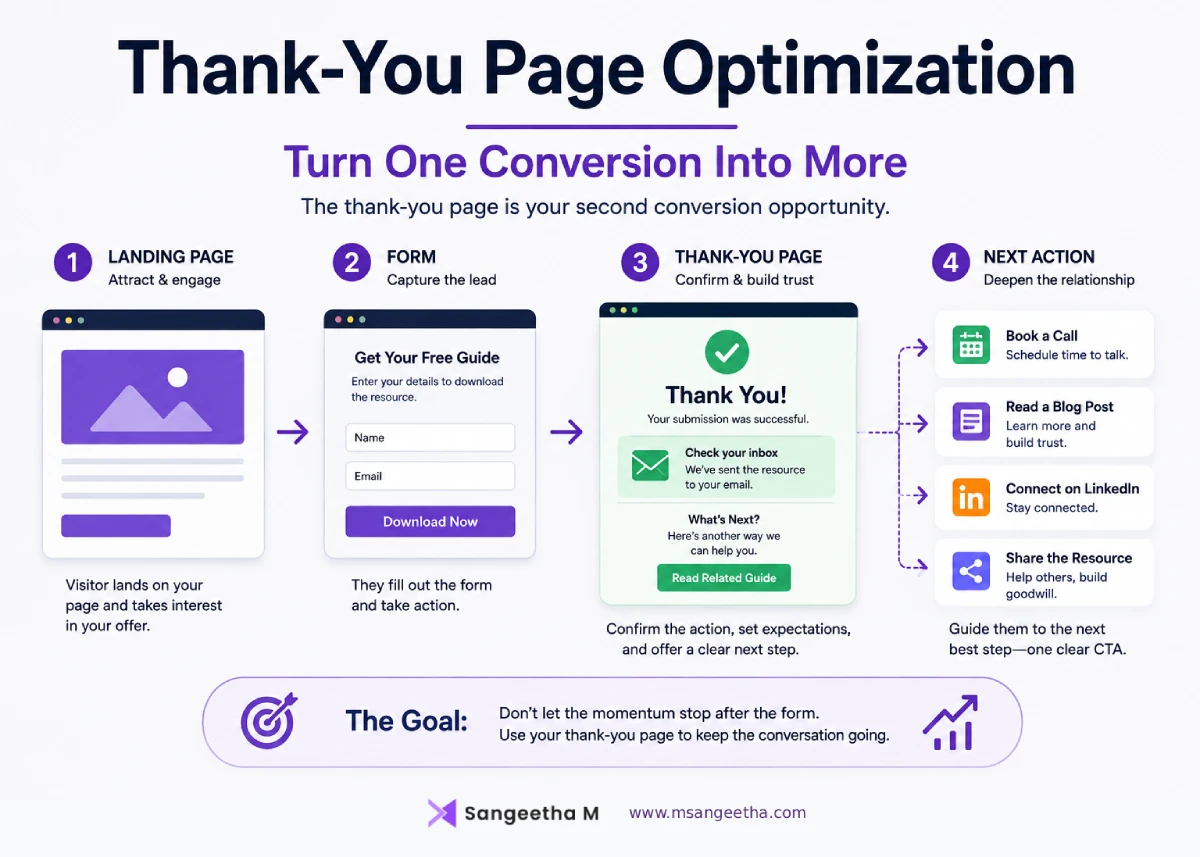
What Belongs on a Thank-You Page
1. Confirm What Just Happened
Say exactly what the visitor should expect next — “Check your inbox for the checklist” or “We’ll call you within 1 business day.” Vague confirmations create doubt, and doubt causes people to resubmit the form or leave without opening the follow-up email.
2. Set Expectations for Follow-Up
Tell them who will contact them, how, and roughly when. If it’s an automated email, say so — it reduces “did this actually work?” support messages.
3. Give Them a Second Action
This is the part most sites skip entirely. Once someone converts, don’t just let them sit there — offer one clear next step:
- Follow you on LinkedIn or Instagram
- Read a related blog post that deepens the relationship
- Book a call directly instead of waiting for outreach
- Share the resource with a colleague
Pick one. A thank-you page crowded with five competing CTAs performs worse than one with a single, obvious next step.
4. Reinforce the Value They Just Got
A short line reminding them why what they just did matters — “You’re one step closer to a faster, more secure WordPress site” — keeps the emotional momentum going instead of letting it flatline into a generic confirmation.
Technical Setup I Always Check
- Unique URL: Every thank-you page needs its own URL (not a modal or on-page message) so it can be used as a goal/destination in GA4 and Google Ads.
- Noindex it: Thank-you pages shouldn’t rank in search — someone landing on it without converting first skews your funnel data and can confuse them. I set a noindex directive via Rank Math’s page-level setting.
- Exclude it from internal navigation and sitemaps: It’s a destination, not a page anyone should browse to.
- Fire conversion events here, not on form submit: Redirect-based tracking is far more reliable than JavaScript event listeners on the form itself, especially with page builders like Divi where form markup can change between updates. Example: Fire a ‘generate_lead’ event in GA4 only when the thank-you page loads.
Common Mistakes I See on Client Sites
- Thank-you page identical in design to every other page, with no acknowledgment that a conversion just happened
- No tracking pixel fired at all — conversions invisible in ad platforms
- A wall of unrelated CTAs (newsletter signup, three blog links, social icons, and a coupon code) competing for attention
- Redirecting back to the homepage instead of a dedicated thank-you page
How This Fits Into a Bigger Lead Gen Strategy
The thank-you page is the final step in the funnel I map out when building lead generation for WordPress websites — it works alongside the lead magnet and content upgrades that got someone to the form in the first place. Optimizing it in isolation helps, but it compounds when the whole path — landing page, form, lead magnet, thank-you page — is designed as one sequence.
Want your lead gen funnel reviewed end to end?
I’ll look at your landing pages, forms, and thank-you pages together and tell you exactly where leads are leaking.
FAQ
Should a thank-you page be indexed by Google?
No. Noindex it. It shouldn’t appear in search results, and keeping it out of the index protects your conversion tracking data from being skewed by non-converting visitors landing there directly.
Can I use a popup instead of a dedicated thank-you page?
You can, but I don’t recommend it. A dedicated URL is essential for accurate conversion tracking in GA4 and ad platforms, and it survives page reloads and browser back/forward navigation better than a modal.
What’s the single most important element on a thank-you page?
Clear confirmation of what happens next. Everything else — the second CTA, the social links, the reinforcement message — is secondary to removing the visitor’s uncertainty about whether their action actually worked.